Is Online Casino Legal in India? State-by-State Guide

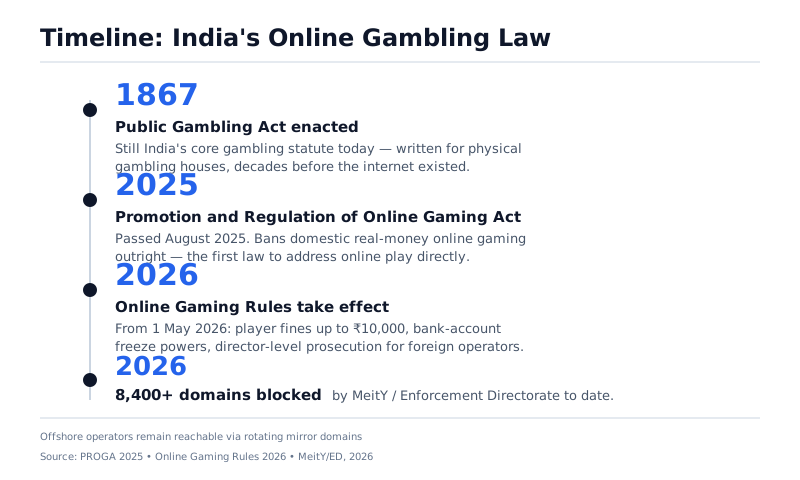
India has no single law that licenses or bans online casinos outright. The starting point for the gaming and gambling laws in india that still govern this space is the Public Gambling Act of 1867 — the country’s core gambling statute, written for physical gambling houses, which never anticipated the internet. That gap is what offshore operators have relied on for over a decade to serve Indian players without operating a licensed business inside the country itself.
That gap narrowed in 2025. The Promotion and Regulation of Online Gaming Act criminalized domestic real-money online gaming outright, and the Online Gaming Rules that took effect on 1 May 2026 gave the ban teeth: player-side penalties of up to ₹10,000, bank-account freeze powers, and director-level prosecution for foreign operators found advertising into India. None of this makes offshore play newly illegal — it was always outside any licensing framework — but it does mean the operators reviewed on this site now carry real regulatory risk on both sides of the transaction.
So, is online casino legal in India, in plain terms? Not domestically licensed, but not specifically named and banned for the individual player either — that gray-zone answer is the real one behind the question “is online casino legal in India” most people are actually asking. The state-wise picture matters too: the same activity that’s a national gray area is more clearly restricted in a handful of specific states, which is why this page covers both the national gaming and gambling laws in India and the state-wise exceptions separately below.
Is Online Casino Legal in India? Understanding the Nuances
The honest answer is “neither clearly legal nor clearly illegal” for a player using an offshore site, which is an unsatisfying answer but an accurate one. India’s central gambling framework has never directly licensed or banned offshore online casinos operated from outside its borders. What the 2025 Act criminalizes is domestic real-money online gaming — platforms operating from within India. Offshore operators licensed in Curaçao or similar jurisdictions, serving Indian players from outside the country, sit in a gray zone the law doesn’t cleanly address either way.
This is different from saying it’s “legal.” No Indian court has affirmatively ruled that using an offshore casino is protected activity, and the 2026 Rules explicitly target advertising and promotion of real-money games with extra-territorial reach — a provision that could, in principle, extend to platforms (including affiliate and review sites) that promote offshore operators to Indian audiences. We describe operators as “licensed in Curaçao” or “accepting Indian players” for this reason, never as “legal in India.”
It’s worth being precise about what “gray zone” actually means in practice, because the phrase gets used loosely. It does not mean the activity is unregulated everywhere — the operator is regulated, just by a foreign licensing body rather than an Indian one. It does not mean no law applies — several laws touch the edges of the transaction (payment processing rules, the 2025 Act’s domestic-operations ban, state-level restrictions) without directly criminalizing the individual player’s act of using a foreign-licensed site. And it does not mean the situation is static — enforcement priorities and rule interpretations have shifted meaningfully in the past two years and are likely to keep shifting.
Games of Skill vs. Games of Chance: The Legal Distinction
Indian gambling law has long drawn a line between “games of skill” and “games of chance,” a distinction that predates online gaming entirely and comes from decades of court rulings on games like rummy and poker. Games of skill have historically received more favorable legal treatment in several states, on the theory that skill-based competition isn’t gambling in the same sense as a pure chance-based casino game. The 2025 Act complicates this distinction for real-money formats specifically — it targets real-money online gaming broadly, regardless of the skill-versus-chance question that shaped earlier case law. Casino games like roulette, slots, and live-dealer blackjack fall unambiguously on the chance side either way, which is part of why they were never going to benefit from the skill-game carve-outs that some fantasy-sports and card-game platforms have argued for domestically.
State-Wise Variation in India’s Gambling Laws
Gambling law in India sits partly with individual states, not only the central government. Andhra Pradesh, Telangana and Tamil Nadu have gone furthest, banning real-money gaming outright within their borders. Karnataka and Chhattisgarh are cited in several 2026 legal summaries as having similar restrictions under consideration or in force. Offshore operators’ own terms of service commonly exclude players from these states, though we’ve found that individual operators are inconsistent about enforcing or even disclosing this — it’s worth checking an operator’s terms directly rather than assuming a blanket policy applies.
| State | Status (2026) |
|---|---|
| Andhra Pradesh | Real-money gaming banned outright |
| Telangana | Real-money gaming banned outright |
| Tamil Nadu | Real-money gaming banned outright |
| Karnataka | Restrictions cited in 2026 legal guides |
| Chhattisgarh | Restrictions cited in 2026 legal guides |
| All other states | No state-specific ban identified; national gray-zone framework applies |
Embed this graphic
Penalties and Legal Consequences for Illegal Online Gambling
The Online Gaming Rules of 2026 introduced player-side penalties that didn’t meaningfully exist before: fines of up to ₹10,000 for individuals, alongside powers to freeze bank accounts linked to real-money gaming transactions. For operators, the exposure is much larger — the 2025 Act allows for director-level prosecution of foreign operators found advertising or promoting real-money games to Indian users, a provision with genuine extra-territorial reach on paper, even though enforcement against operators based entirely outside India remains difficult in practice.
This is a meaningful shift from the pre-2025 environment, where enforcement was almost entirely aimed at domestic operators and payment intermediaries rather than individual players. We’d treat the player-penalty provisions as a real, if unevenly enforced, risk rather than a theoretical one.
Government Crackdown and Enforcement Against Illegal Operators
The Ministry of Electronics and IT, working with the Enforcement Directorate, has blocked more than 8,400 betting and gaming domains as of early 2026 — a figure that keeps climbing as operators rotate to new mirror domains faster than individual URLs can be blocked. This is why affiliate links on this site route through a redirector rather than pointing at a fixed operator domain: the redirector can be updated when a domain is blocked without breaking every link on the site pointing to it, and it means a domain block doesn’t necessarily indicate an operator has shut down entirely.
Enforcement has also increasingly targeted the “Betting ID” ecosystem — informal bookmaking run through WhatsApp and Telegram rather than any licensed platform. Several criminal cases involving this specific model have made national news in 2026; we treat any mention of a “Betting ID” arrangement as a distinct and higher-risk category from even the weakest licensed offshore casino, since it carries zero licensing or dispute-resolution structure at all. Most of the banned betting apps in india that MeitY has targeted fall into this unlicensed-bookmaker category rather than the offshore-licensed operators reviewed on this site — a distinction that gets lost in most reporting on banned betting apps in india generally.
Two questions come up constantly in reader messages, so we’ll answer them directly here rather than only in the FAQ below. First: can we play online casino in India at all right now? Yes, on the offshore platforms we review, in the same gray-zone sense described throughout this page — can we play online casino in India without domestic licensing is really the more precise version of that question, and the answer is the same gray zone every time. Second: what’s the actual online gambling laws and punishment in India picture for a player, as opposed to an operator? Currently it’s the 2026 Rules’ fine structure (up to ₹10,000) and account-freeze powers — the online gambling laws and punishment in india framework is aimed more at deterrence than at large-scale individual prosecution so far.
The Future of Online Gambling Laws in India
Legal commentary through 2026 generally expects enforcement focus to sharpen on payment rails and advertising rather than expanding to prosecute individual players at scale — blocking UPI settlement for gambling transactions and pursuing platforms that advertise into India are both cheaper and more scalable enforcement levers than pursuing millions of individual users. Whether India eventually moves toward a licensed domestic framework (as some state lotteries and skill-gaming platforms have pushed for) or toward tighter enforcement of the current ban remains genuinely unresolved, and we’d treat any confident prediction either way with skepticism.
What This Means When Choosing an Operator
Because no offshore casino is licensed within India, “is this legal” isn’t a question any operator can answer differently from another — they’re all in the same gray zone. What actually varies between operators, and what’s worth spending your evaluation time on instead, is whether an operator’s Curaçao (or equivalent) licence is genuinely verifiable, whether it publishes wagering terms in full, and whether it has a track record of paying out withdrawals without unresolved disputes. Our operator rankings and individual operator reviews weight exactly these factors, in that order, because they’re the ones that actually differ from platform to platform.
It’s also worth separating two distinct risk categories that get conflated in casual conversation: using a licensed offshore operator (the gray-zone situation this entire page describes) versus using an unlicensed local “Betting ID” arrangement through WhatsApp or Telegram (a materially higher-risk category with no licensing or dispute process at all). The legal uncertainty around the first category doesn’t make the second category equivalent — they carry very different practical risk even though neither is licensed within India.
Payment reliability is one of the more practical ways this gray zone shows up day to day — see our UPI casino payment guide for how individual operators actually perform on deposits and withdrawals. If you’re specifically weighing a newer, less-established operator, our new casinos page covers how we handle platforms that don’t have a payout track record yet.
None of this is a substitute for reading the actual gaming and gambling laws in india that apply to your specific state, and none of it changes if is online casino legal in india becomes a clearer yes-or-no in a future amendment — we’ll update this page the day that happens.
Tax Treatment of Winnings
Separately from the legality question, winnings from games of chance — including casino games — are taxed under Section 194BA at a flat 30% TDS rate, with no basic exemption threshold the way regular income has one. GST considerations can apply on top of the TDS depending on how a platform structures its offering. This tax obligation applies regardless of whether the underlying platform is itself in a legal gray zone; the two questions are handled separately under Indian law. This is general context, not tax advice specific to your situation — a tax professional is the right resource if you’re unsure how this applies to you.
Frequently Asked Questions
Is Stake banned in India?
Stake’s main domain (stake.com) is among the sites blocked by Indian authorities, so it isn’t directly reachable from an Indian IP address without a mirror or VPN. It hasn’t been “banned” for individual users in the sense of being made newly illegal to use — it sits in the same offshore gray zone as every other operator on this list, just with a blocked primary domain.
Is gambling legal in India?
Physical, in-person gambling is regulated state-by-state under laws descending from the Public Gambling Act of 1867, with some states permitting licensed casinos (Goa, Sikkim) and most prohibiting it outright. Online real-money gambling is a separate question: domestic online real-money gaming was banned outright by the 2025 Promotion and Regulation of Online Gaming Act, while offshore platforms serving Indian players from abroad remain in an unaddressed gray zone.
Is betting legal in India?
Sports betting follows the same general framework as casino gambling: no domestic licensed market, offshore operators serving Indian players from abroad in a legal gray zone, and the 2025 Act specifically banning domestic real-money online gaming operations. A few states permit certain skill-based formats domestically, but real-money sports betting itself isn’t licensed anywhere in India.
Is Parimatch legal in India?
Parimatch operates under a Curaçao licence and accepts Indian players from outside the country’s borders, the same structure as every other operator we review. It is not “illegal” in the sense of Indian law specifically naming and banning it, but it is also not licensed within India — the same gray-zone framing applies as to any offshore operator.
Is online betting legal in India?
The same gray-zone answer applies to online betting as to online casino play: no central law affirmatively permits it, the 2025 Act bans domestic real-money operations specifically, and offshore platforms serving Indian users from abroad remain in a legal space the law doesn’t cleanly address either way.
Is casino gambling legal in India?
Land-based casino gambling is legal only in a small number of states and territories that specifically license it, primarily Goa, Daman, and Sikkim. Online casino play through offshore operators is the separate gray-zone situation described throughout this page — neither affirmatively legal nor specifically banned for the player.
Is online casino legal in India?
No Indian law currently licenses domestic online casinos, and the 2025 Promotion and Regulation of Online Gaming Act bans domestic real-money online gaming outright. The offshore operators reviewed on this site are licensed abroad (typically Curaçao) and accept Indian players from outside the country’s borders, which is why the market is best described as a legal gray zone rather than clearly legal or illegal.
Which Indian states have explicitly banned online real-money gaming?
Andhra Pradesh, Telangana, and Tamil Nadu have gone furthest, banning real-money gaming outright within their borders. Karnataka and Chhattisgarh are cited in several 2026 legal summaries as having similar restrictions under consideration or already in force.
Is it legal to play on offshore or foreign-based casino sites from India?
It falls into the same gray zone described throughout this page: not licensed within India, but also not specifically named and banned by Indian law for the individual player using a foreign-licensed platform from outside the country. The 2025 Act’s ban targets domestic operations rather than individual offshore play, though the 2026 Rules’ extra-territorial advertising provisions add a new layer of uncertainty.
Do I have to pay tax on my online casino winnings in India?
Yes. Winnings from games of chance are taxed under Section 194BA at a flat 30% TDS rate with no basic exemption, regardless of whether the platform itself is domestic or offshore. GST considerations can apply on top of that. This is general context, not individual tax advice.
How can I tell if an online casino site is safe and reputable?
Check for a verifiable offshore gambling licence against the regulator’s own public register, read the full wagering terms rather than the marketing summary, and look for a payout history free of unresolved public complaints. We verify all three before listing any operator on this site.
What are the risks of using unregulated "Betting IDs" from local bookies?
A Betting ID sold informally through WhatsApp or Telegram routes your money through an unlicensed local bookmaker with no licence, no dispute process, and no accountability if the operator disappears with a deposit. This is a materially higher-risk category than even the weakest licensed offshore casino, and several criminal cases involving this exact model have made national news in 2026.
What is the legal age for online gambling in India?
18. Every operator reviewed on this site requires age confirmation at signup, and this site does not review or recommend any platform without that requirement in place.
What's the difference between a game of skill and a game of chance under Indian law?
Indian courts have historically given games of skill (such as rummy) more favorable legal treatment than pure games of chance, on the theory that skill-based competition isn’t gambling in the traditional sense. Casino games like roulette, slots, and live-dealer blackjack fall unambiguously on the chance side, and the 2025 Act’s real-money gaming ban applies broadly regardless of this older skill-versus-chance distinction.
What happens if I get caught using an offshore casino from a restricted state?
We’re not aware of confirmed cases of individual players in restricted states (Andhra Pradesh, Telangana, Tamil Nadu) being prosecuted specifically for using an offshore casino, but the 2026 Rules’ player-side penalties (fines up to ₹10,000, account-freeze powers) apply nationally and enforcement priorities can shift. If you’re in a restricted state, treat the legal exposure as genuinely higher, not theoretical.
Can offshore casino operators be prosecuted under Indian law?
On paper, yes — the 2025 Act allows director-level prosecution of foreign operators found advertising or promoting real-money games to Indian users, with extra-territorial reach. In practice, enforcement against operators based entirely outside India’s jurisdiction remains difficult, which is part of why the offshore market has continued operating despite the law.
18+. This page describes the regulatory landscape as of July 2026; it is not legal advice. If you are uncertain whether online gambling is permitted where you live, consult a legal professional in your state before playing. See our operator rankings and responsible gambling resources for related reading.